Rules
1.The grid is already full of numbers. You do not write numbers in. You cross them out.
2.Next to every row and under every column stands a target. When you are done, the numbers you have left standing in that row must add up to exactly the target. Numbers you have crossed out do not count.
3.Every row and every column has to come out right at the same time, and each number belongs to one row and one column at once.
4.A number may appear many times in the grid. Two cells holding the same number are two separate decisions: crossing out one says nothing about the other.
5.The puzzle is solved when every one of the targets is met exactly. There is only one way to do it.
How to solve
1.Find a line that has only one possible selection. Take a row, look at its target, and write down every set of its numbers that adds up to it. Sometimes there is exactly one, then the whole row is settled at once: those numbers stay, all the others go. Start with the smallest and the largest targets; they are the ones with the fewest possibilities.
2.Take what is common to all possibilities. This is the deduction the puzzle rests on, and it works even when a line has several selections. List them all, then ask two questions about each number in the line: does it appear in every one of them? Then it stays, whatever happens later, as long as that number sits in the line only once. Where the same number fills two cells, you know only that one of the two survives. Does it appear in none of them? Then it is struck out, doubles included. Numbers that appear in some but not all stay undecided for now.
3.Cross the lines. Every cell sits in a row and in a column. A decision made in a row cuts down the possibilities of its column immediately, and that is usually where the next deduction comes from. Go back and forth rather than finishing all the rows first.
4.Watch the extremes. A target equal to the sum of the whole line means nothing is crossed out there. Where a single number reaches the target and no combination of the others does, the line is settled at once. A target smaller than the smallest number in the line means you misread it.
Mark a crossed-out number with a stroke and a kept number with a ring or a tick. Do not rely on memory: the difference between decided to keep and not looked at yet is the whole puzzle.
Worked example
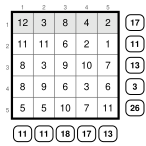
A 5×5 grid. The numbers are printed, the targets stand in the capsules at the right and below. Solving means striking out; a number that survives is printed in bold here.
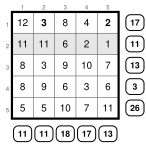
Step 1. Row 1 must reach 17 out of 12, 3, 8, 4 and 2. Only two combinations get there: 12 + 3 + 2; 3 + 8 + 4 + 2. The 2 and 3 appear in every one of them, so they stay.
Step 2. Row 2 must reach 11 out of 11, 11, 6, 2 and 1. Only 11 gets there, but it appears twice in the line, so it is not yet decided which one survives. Either way the 1, 2 and 6 are in no combination, so they go.
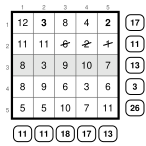
Step 3. Row 3 must reach 13 out of 8, 3, 9, 10 and 7. Only one combination gets there: 3 + 10. With a single combination left, the whole line is decided.
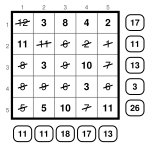
The remaining six steps work exactly the same way: pick a line, list what still reaches its target, keep what is in every combination, strike what is in none. The finished grid: