← All puzzle kinds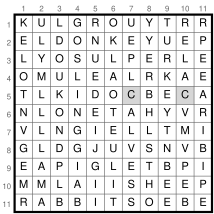
Word Search
Rules
1.Every word on the list is hidden in the grid exactly once, written in a straight line, one letter per cell.
2.Which directions are used depends on the difficulty:
•Easy: left to right and top to bottom. Nothing else: no diagonals, nothing backwards.
•Medium: left to right, top to bottom, and the two diagonals down-right and up-right. Still no words running backwards.
•Hard: all eight directions, backwards and upwards included.
3.Words may cross and share letters. A letter can belong to two words at once.
4.A word never bends and never skips a cell.
5.Every remaining letter is filler. No word from the list appears anywhere else in the grid, in none of the eight directions, whichever difficulty you are on. If you have found a word, you have found the word.
6.The puzzle is solved when every word on the list has been struck through.
How to solve
1.Start with the rare letters. Q, X, Z, J, K, V and W occur only a handful of times in a grid. Pick the word with the rarest first letter, find the few cells that carry it, and test the allowed directions from each. That is far faster than reading the grid line by line.
2.Scan one direction at a time. Once you switch to reading, read the whole grid in a single direction, all rows left to right, for example, before switching. Mixing directions is how words get missed.
3.Use the letters you have already struck through. Words share letters. A letter that is part of a found word is a good starting point for the next one.
4.Leave the short words for last. Long words are constrained by the grid size and sit in far fewer places; a five-letter word can be almost anywhere.
Worked example
A real Easy grid on the theme Farm Animals. Rather than reading it line by line, start with the word whose first letter is rarest.
Counting the letters in this grid, C is the rarest first letter of any word on the list, occurring 2 times. So take CALVES and test the allowed directions from each of those cells.
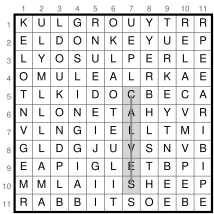
From r5c7 the word runs downwards, and there it is.
That is the whole method. Words cross and share letters, so a letter you have already struck through may turn out to belong to a second word as well. The long words are worth doing first: a nine-letter word fits in far fewer places than a five-letter one.