Rules
1.The grid is divided into regions outlined by heavy lines. Every region in a puzzle has the same number of cells, N.
2.Each region contains the numbers 1 to N, each exactly once.
3.Two equal numbers must never touch: neither side by side, nor above one another, nor diagonally.
4.Rows and columns carry no rule of their own. The same number may appear twice in a row, as long as rule 3 is respected.
5.Some numbers are printed; the rest are yours to fill in.
6.The puzzle is solved when every cell holds a number and rules 2 and 3 hold everywhere.
How to solve
1.Cross out, then take the single. A printed number removes itself from every neighboring cell, up to eight of them, and from every other cell of its own region. Do that for all printed numbers first. Any cell left with a single candidate is solved.
2.Hidden single in a region. If, inside one region, a number can only go into one cell, it goes there, even if that cell still has other candidates of its own.
3.Neighbor exclusion. Look at a number d that still has several possible cells in its region. If every one of those cells touches the same outside cell X, then X cannot be d, wherever d ends up. This is the technique that makes a Suguru hard without ever making it a guessing game.
Apply them in that order: 1 until it stalls, then 2, and only then 3.
Worked example
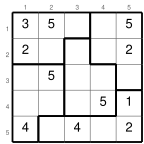
A 5×5 grid, Hard. The heavy lines mark the regions; a region of five holds the digits 1 to 5. The full solution takes 15 steps. Shown here is the first time each of the three techniques is needed.
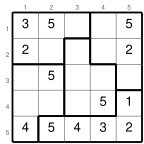
Step 1, the naked single. r5c4 can only be 3: every other digit of its region has been ruled out for this cell.
One more step of that kind follows before the next technique is needed. The grid now looks like this:
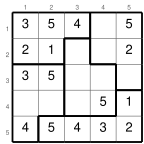
Step 3, the neighbor exclusion. In the region that holds r1c4 and r1c5, the 1 can only go on r1c4 or r2c4, and every one of those cells touches r1c3. Wherever the 1 lands, r1c3 cannot be a 1.
Three more steps follow before the next technique is needed. The grid now looks like this:
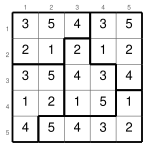
Step 7, the hidden single. In the region around r3c5 the 4 fits nowhere else, so that is where it goes, even though the cell itself still had other digits open.
From there the naked single carries the rest: