Sudoku
Rules
How to solve
The solver that gave every Sudoku in this book its difficulty label knows the 6 techniques below, and nothing else. It never guesses, and a puzzle it cannot finish was thrown away instead of being labelled. The label is relative to exactly this list: if you know more techniques, a Hard puzzle will feel easier than the label promises.
Work technique 1 until it stalls, then 2, and so on. After every success go back to the top: a single new digit usually re-opens the cheap techniques.
Worked example
A Hard grid. The small digits are pencil marks, the candidates a cell still allows. Writing them in is the whole preparation; everything after that is crossing them out.
56 of the 59 steps are naked and hidden singles, and those need no explanation: a cell with one candidate left, or a digit that fits nowhere else in its unit. Shown below are the 3 places where that is not enough.
Step 16, Pointing. In box 9 the 7 appears only in row 8. Wherever it lands inside the box, it takes that row, so the 7 leaves the rest of row 8.
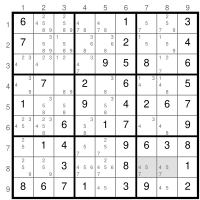
Step 17, X-Wing. The 2 sits in exactly two cells of column 3 and in exactly two cells of column 8, and both pairs share rows 1 and 3. Those four cells form a rectangle: whichever way it falls, the two rows are taken, so the 2 leaves them everywhere else.
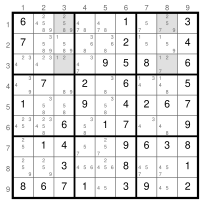
Step 18, Naked Pair. r3c1 and r3c2 hold nothing but 3 and 4. Those two digits belong to those two cells, so they leave the rest of row 3.
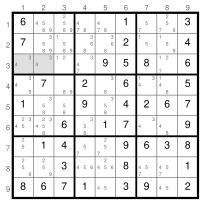
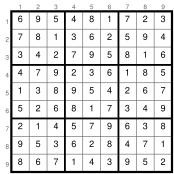
The finished grid:
One more technique: the hidden pair
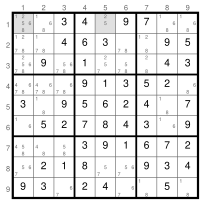
This one did not come up in the grid above, so here it is in another Hard puzzle, at its step 24.
In row 1 the 2 and 5 appear in no cells but r1c1 and r1c5. Those two cells must take those two digits, so every other candidate there is gone.