Shikaku
Rules
How to solve
A placement of a number is a rectangle of the right area that contains this number and no other one. At the start every number has a few of them. Solving means striking placements until each number has exactly one left.
Start with the numbers that have the fewest shapes. A 1 is fixed from the start, and a 2, 3, 5, 7, 11 or 13 can only be a straight strip, one cell wide. Numbers such as 6, 8 or 12 have many shapes and usually come last.
Work 1 until it stalls, then 2, and use 3 when both are stuck. The difficulty label counts how often technique 1 alone is not enough: Easy never, Medium three or four times, Hard eight times or more.
Worked example
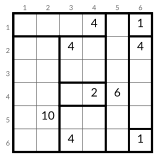
A 6×6 grid, Medium, with 9 numbers. Solve along with the text. The small gray numbers at the edge count the rows and columns; they do not appear on the puzzle pages. The full solution takes 12 steps.
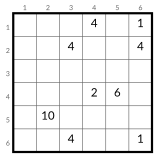
Step 1, single placement. The 1 in row 1, column 6 has only one rectangle left: row 1, column 6. Draw it.
Step 2, single placement. The 1 in row 6, column 6 has only one rectangle left: row 6, column 6. Draw it.
The grid now looks like this.
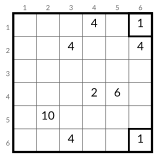
Step 3, only claimant. No number except the 4 in row 6, column 3 can reach row 6, column 4. So its rectangle must cover that cell, and one placement that leaves it out is gone.
Step 4, only claimant. No number except the 4 in row 2, column 3 can reach row 3, column 3. So its rectangle must cover that cell, and three placements that leave it out are gone.
The grid now looks like this. Gray marks the cell the last step was about.
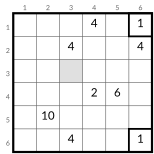
Step 5, core cells. The 4 in row 2, column 6 still has two possible rectangles, but every one of them covers row 3, column 6. That cell belongs to the 4 already, so one placement of another number that reached into it is gone.
The grid now looks like this. Gray marks the cell the last step was about.
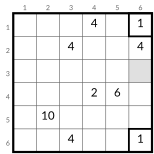
Step 6, single placement. The 6 in row 4, column 5 has only one rectangle left: rows 1 to 6, column 5. Draw it. That rules out four placements of other numbers that reached into it.
Step 7, single placement. The 4 in row 1, column 4 has only one rectangle left: row 1, columns 1 to 4. Draw it. That rules out two placements of other numbers that reached into it.
Step 8, single placement. The 4 in row 2, column 6 has only one rectangle left: rows 2 to 5, column 6. Draw it.
Step 9, single placement. The 10 in row 5, column 2 has only one rectangle left: rows 2 to 6, columns 1 to 2. Draw it. That rules out two placements of other numbers that reached into it.
Step 10, single placement. The 4 in row 6, column 3 has only one rectangle left: rows 5 to 6, columns 3 to 4. Draw it. That rules out two placements of other numbers that reached into it.
Step 11, single placement. The 4 in row 2, column 3 has only one rectangle left: rows 2 to 3, columns 3 to 4. Draw it. That rules out one placement of another number.
Step 12, single placement. The 2 in row 4, column 4 has only one rectangle left: row 4, columns 3 to 4. Draw it.
Every number now has its rectangle and every cell is covered. That is the solution: