Slitherlink
Rules
How to solve
Draw lines, and mark every side that cannot belong to the loop with a small x. This is the whole trick. The crossing rule below works by counting lines and x's at a dot; without the x's on paper there is nothing to count, and the puzzle looks stuck when it is not.
The three cases at a crossing, from left to right, each before and after:

Most of the work happens at the crossings, not at the numbers. Measured over ten Easy puzzles of this book: 386 of 601 deductions, about two in three, came from rule 3.
The level tells you what you need: Easy uses 1 to 4, Medium adds 5, Hard adds 6. You never have to guess and undo.
Worked example
A 6×6 grid, Easy, 15 numbers. Solve along with the text. The small numbers at the edge name the rows and columns. Lines are black, an x marks a side that is ruled out, and a gray shade shows what is new in each picture.
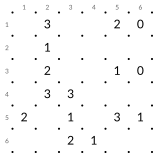
Steps 1 to 2, rule 1. The 0s first: row 1, column 6; row 3, column 6. Each gets an x on every side that does not have one yet. These are the first x's, and they cost nothing.
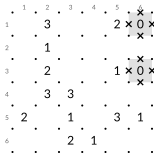
Step 3, rule 3. No line reaches the top left corner of row 1, column 6 and only one side is still open there. A single line would be a dead end: put an x on it.
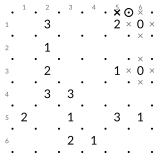
Step 4, rule 2. The 2 in row 1, column 5 still needs 2, and exactly two sides are open. Draw them all.
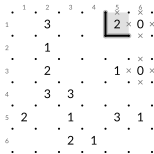
Step 5, rule 3. Two lines already meet at the top left corner of row 2, column 5. Put an x on the rest.
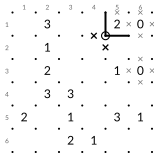
Step 6, rule 3. A line ends at the top left corner of row 1, column 5 and only one side is still open there. The line has to continue that way.
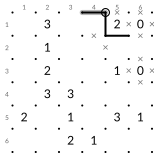
Steps 7 to 8: rules already shown, 2 times.
Step 9, rule 2. The 1 in row 3, column 5 already has its line. Put an x on the remaining two sides.
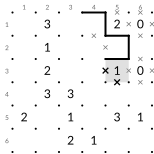
Steps 10 to 13: rules already shown, 4 times.
Step 14, rule 4. No simple rule applies here. At the top left corner of row 5, column 6 the loop can pass in only a few ways that fit the numbers around it. All of them agree on three sides. The crossing is circled, and the sides all ways agree on are shaded.
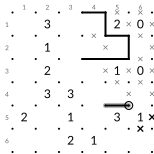
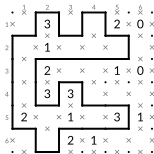
The remaining 42 steps (15 to 56) need nothing new. Of all 56 steps in this example, 39 come from the crossing rule. The finished loop: