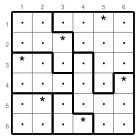
Star Battle
Rules
If you know Star Battle with two stars per row: here it is one, everything else is the same.
The five rules of deduction
Every puzzle in this book can be solved with the five rules below and nothing else. The difficulty label counts how many starting points lie open at the tightest moment: Easy four or more, Medium two or three, Hard exactly one, and you have to find it.
Mark ruled-out cells with a dot; it is the only way to keep track.
How to solve
Work down the list. A hard grid rarely opens with A: look for C, D or E first.
Worked example
A 6×6 grid, Easy. Solve along with the text. Every rule from the list above turns up here. The gray letters name the regions; they are only for this explanation and do not appear on the puzzle pages.
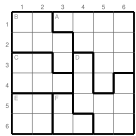
Nothing simple works yet. No row, column or region is down to a single free cell, so rule A finds nothing, and no region sits inside one line, so C finds nothing either. That is the normal opening of a Star Battle.
Whenever you place a star below, rule B immediately empties its row, its column, its region and the eight cells around it. That is not repeated every time.
Step 1, rule E. The free cells of regions E and F all lie in rows 5 and 6. Those two rows belong to those regions alone, so every other cell there is out. Out: r5c4, r5c5, r5c6, r6c5, r6c6.
Step 2, rule D. All free cells of column 5 lie inside region A, so that region's star is in this column, and its cells elsewhere are out. Out: r1c3, r1c4, r1c6, r2c4, r2c6, r3c6.
The grid now looks like this. A dot marks a cell that is ruled out, a star a placed star.
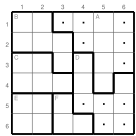
Step 3, rule A. Column 6 has only one free cell left, so the star goes on r4c6.
Step 4, rule A. Column 4 has only one free cell left, so the star goes on r6c4.
Step 5, rule C. All free cells of region C lie in row 3, so that line's star must be inside the region, so the rest of the line is out. Out: r3c3.
Steps 6 to 9, rule A throughout. Nothing clever is left. Each star you place empties enough cells that the next unit falls to a single free cell, and that one to the next: Column 3 to r2c3, Region A to r1c5, Region C to r3c1, Region E to r5c2.
The finished grid: