Rules
1.The grid holds equations. Each equation is five cells in a straight line: a number, an operator, a number, an equals sign, a number. Read horizontal equations from left to right, vertical ones from top to bottom.
2.A cell holds a whole number, not a single digit. All numbers are between 1 and 99.
3.Where a horizontal and a vertical equation cross, they share a cell. That one number has to satisfy both equations.
4.Below the grid, under Numbers to place, is the pool. It holds exactly as many numbers as there are empty cells. Every number in the pool is used exactly once, and nothing outside the pool may be used. The pool is part of the puzzle, not a convenience: without it most of these grids would have several solutions.
5.The same number can appear twice in the pool. Duplicates make the puzzle harder, not easier, because the argument "only one tile left, so it must go here" no longer works for them.
6.Division is only ever used where it comes out exact, with no remainders and no fractions.
7.There is nothing to decide about the order of operations: every equation has exactly two operands.
8.Easy puzzles use + and − only. Medium adds ×. Hard adds ÷ as well.
9.The puzzle is solved when every cell is filled, every pool number is used exactly once, and every equation is true.
How to solve
1.Look for an equation with only one gap. It resolves on the spot. In an Easy puzzle most equations start out that way; in a Hard puzzle usually none do, and you have to begin with step 2.
2.Check the pool against the gap. Go through the pool number by number and ask whether it could go in this cell. Rule out the impossible ones as you go. This is the step people skip, and it is the strongest one. The pool is short, and most of it usually fails immediately.
3.Use the crossings. A cell that belongs to two equations must satisfy both. Once one equation narrows it to two or three candidates, the other one usually settles it.
4.Try the reverse: place a number from the pool. If a pool number fits into only one remaining cell, it goes there, even if that cell still had other candidates.
Worked example
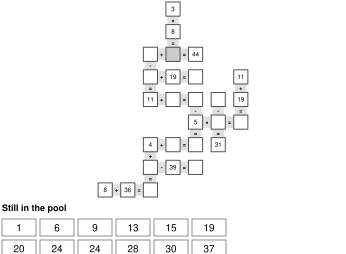
A Medium grid with 13 equations and 14 gaps. Every number under the grid goes into exactly one gap, and every gap takes exactly one of them. That pool is not decoration. It is what limits the candidates in the first place.
Step 1. The highlighted cell sits in 3 × 8 = ?. That equation has one gap left, and working it out gives 24, which is still in the pool.
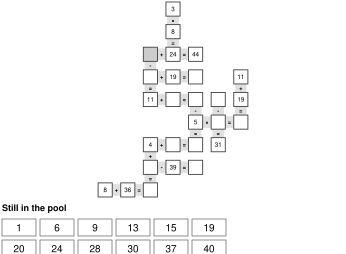
Step 2. The highlighted cell sits in ? + 24 = 44. That equation has one gap left, and working it out gives 20, which is still in the pool.
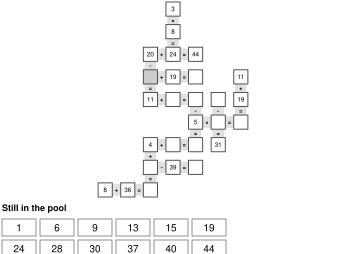
Step 3. The highlighted cell sits in 20 - ? = 11. That equation has one gap left, and working it out gives 9, which is still in the pool.
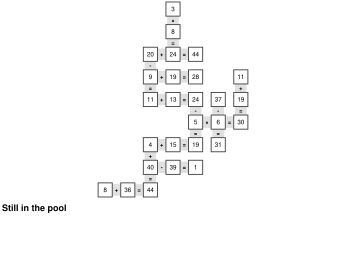
The remaining 11 gaps go the same way: find an equation with one gap left, work it out, cross the number off the pool. Each number you place opens the next equation.