← All puzzle kinds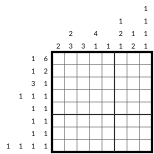
Nonogram
Rules
1.Every cell is either filled or empty. The numbers tell you which.
2.The numbers to the left of a row give the lengths of the filled blocks in that row, in the order they appear. The numbers above a column do the same for the column.
3.Between two blocks there is at least one empty cell. Before the first and after the last block there may be any number of empty cells, including none.
4.A row or column that is completely empty is marked with a single 0.
5.Every puzzle in this book has exactly one solution and can be solved by reasoning alone. You never have to try a filling and take it back.
6.The light lines every five cells are a counting aid only; they carry no rule.
How to solve
1.Take the free lines first. A line is settled outright when the numbers plus the compulsory single gaps between them add up to the length of the line. For a line of 8, the clue 1 6 needs 1 + 1 + 6 = 8, so there is only one way to lay it out. A 0 line is settled too: cross the whole line out.
2.Overlap. Push a block as far to one end of its line as it will go, then as far to the other end. Cells that are covered both times are filled, whatever happens later. A block of length L in a line of length n always gives you 2L − n filled cells this way, so it is worth doing whenever a block is longer than half the line.
3.Work across. Every cell you settle in a row is also a cell in a column. Re-read the crossing line immediately; that is where the next deduction usually is. Keep alternating rows and columns rather than finishing one direction first.
4.Mark the empties. Put a dot or a small cross in cells you have ruled out. A nonogram is lost far more often by losing track of the empty cells than by miscounting the filled ones.
Worked example
An 8×8 Medium puzzle:
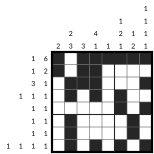
Row 1 reads 1 6. That needs 1 + 1 (gap) + 6 = 8 cells, exactly the width of the grid. There is only one arrangement: filled, empty, then six filled. The whole row is settled before anything else is known.
Column 4 reads 4 1. That needs 4 + 1 + 1 = 6 cells in a column of 8, so there are two cells of slack. Slide the block of 4 to the top: it covers rows 1–4. Slide it to the bottom: it covers rows 3–6. Rows 3 and 4 are covered either way, so column 4, rows 3 and 4 are filled. Nothing else in that column is decided yet. The overlap gives you exactly those two cells.
The finished picture: