Rules
1.Draw one single closed loop through the centres of the cells. It runs horizontally and vertically only, never diagonally.
2.The loop never crosses itself and enters no cell twice.
3.In the puzzles of this book the loop passes through every single cell. No cell is left out. That is not a lucky accident, it is how these puzzles are built, and you are meant to use it: every cell has exactly two ends of the loop, and as soon as only two of its links are still open, both of them belong to the loop.
4.Through a light pearl the loop runs straight, and in at least one of the two cells it reaches on either side it makes a turn.
5.At a dark pearl the loop makes a turn, and from there it runs straight through the next cell in both directions.
6.A cell without a pearl sets no condition of its own. The loop may run straight through it or turn in it, and rule 3 still says it has to pass through.
7.There is exactly one solution, and reasoning always gets you there.
How to solve
Draw what you know, and cross out the links you have ruled out. The crossings are half the work: most of the deductions below come from counting what is left at a cell, and without the crossings on paper there is nothing to count.
1.Every cell is on the loop. Two ends, never one, never three, never none. If two links of a cell are drawn, cross out its other links. If only two are still open, draw them both.
2.The light pearl runs straight. Either both its side links or both its up and down links, never one of each.
3.The dark pearl turns. One horizontal link and one vertical link, never two of a kind.
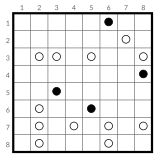
4.The edge decides. Whatever would point off the grid does not exist, and that is usually the fastest way in. In one Medium puzzle: the light pearl at row 3, column 8 sits in the last column. It has to run straight, and horizontally it cannot, so it runs vertically. Two links drawn and one crossed out from a single glance. In the same puzzle: the dark pearl at row 1, column 6 sits in the top row. It has to turn and to carry on straight for one cell in both directions, and upwards there is nothing, so one of its arms goes down. In another Medium puzzle: a dark pearl in a corner is the best gift the grid can give you. It has exactly one turn available, into the grid, and both arms then run straight through the next cell. Four links from one pearl, with nothing to decide. A light pearl on the other hand can never stand in a corner: it would have to run straight, and a corner offers only one link in each direction.
5.The dark pearl reaches two cells. Both of its arms run straight through the next cell. That is a statement about the neighbours, not only about the pearl. In one Medium puzzle: two dark pearls stand side by side at row 4, columns 5 and 6. No line can run between them: whichever of them it left, it would have to run straight through the other one, and a dark pearl turns. Each of the two therefore goes away from its neighbour.
6.The light pearl forbids two straights. It runs straight, and the loop must turn in at least one of the two cells it runs into. In one Medium puzzle: three light pearls stand above each other at rows 2, 3 and 4 of column 5. The middle one runs across, not along. If all three ran along the column, the middle one would have a straight run in both of its neighbours, which it is not allowed.
7.No early ring. A link that would close a ring now, while cells or pearls are still outside it, is crossed out. There is only one loop, and it has to collect everything in the end. In one Medium puzzle: at one point the pieces r6c1 to r7c1 to r8c1 to r8c2 to r7c2 to r6c2 are drawn, an open chain of six cells. The link between r6c1 and r6c2 would close it into a ring of six cells while 58 others are still outside, so it is crossed out.
8.The short trial. When nothing above moves any more, take one open link on the edge of what you have already drawn, assume it is there or assume it is not, and carry on with 1 to 7. Keep it short: at most three passes and at most ten links. If it runs into a contradiction, you know the link the other way round. If not, put the assumption back. In a Hard puzzle: techniques 1 to 7 stall with sixteen links still open. Assuming the link between r3c2 and r3c3 is not there collapses inside the allowed three passes, so that link belongs to the loop.
Medium uses 1 to 7. Hard adds the short trial. There is no Easy level: a Masyu that would deserve the name gives the reader no way in.
Worked example
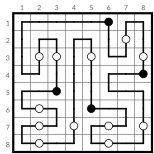
Medium, 8x8, sixteen pearls, twelve light and four dark.
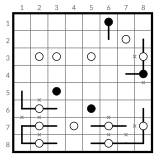
The small grey numbers along the edges count rows and columns; they are not printed on the puzzle pages. A drawn piece of the loop is a black line, and a small cross marks a link that has been ruled out.
Step 1, the dark pearl in the top row. Row 1, column 6. It has to turn, and from each arm the loop runs straight through the next cell. Upwards there is no next cell, so no arm goes up, and the downward link is drawn.
Step 2, the light pearl in the last column. Row 3, column 8 must run straight. Sideways it would leave the grid, so it runs up and down: the links to row 2 and to row 4 are drawn, the link to column 7 is crossed out.
Step 3, the dark pearl below it. Row 4, column 8 must turn. Its upward link is already drawn by step 2, so the other arm is horizontal, and to the right there is nothing. The link to column 7 is drawn and the link down to row 5 is crossed out.
Step 4, three light pearls stacked at the bottom. Rows 6, 7 and 8 of column 2 all carry a light pearl. The one in row 8 sits in the bottom row, so it cannot run vertically and runs across instead, which crosses out the link up to row 7. That leaves the pearl in row 7 no vertical run either, so it runs across too, and the same then holds for row 6. Three pearls, nine links, all from the edge.
From here the same four moves carry the whole puzzle. Over all 71 deductions, 46 come from what a cell without a pearl still allows, 16 from the pearls themselves and 9 from the reach of a pearl into its neighbours. The ring rule is never needed in this one, and neither is the trial. And that count is from a solver that does not use rule 3, so a reader who keeps "no cell stays empty" in mind gets there in fewer moves, not more.