← All puzzle kinds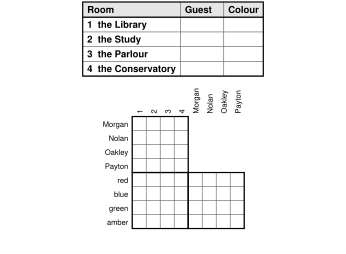
Logic Grid
Rules
1.Every category holds the same number of members. Each member of one category belongs to exactly one member of every other category, and each member is used exactly once.
2.All clues are true, and together they leave exactly one possible assignment. On the easier puzzles some clues are there to help rather than because the solution needs them; on the hard ones every clue earns its place.
3.Clues come in these forms:
•a positive statement, such as "Casey owns the parrot."
•a negative statement, such as "Avery does not drink tea."
•a statement joining two non-name categories, such as "The one who owns the cat drinks tea."
4.When the scenario places its subjects in a numbered row, further clue forms appear, and they refer to that printed order: somewhere to the LEFT / RIGHT of, IMMEDIATELY to the left / right of, next to (either side), exactly n away (either side), and somewhere between X and Y (strictly between, in either order).
5.The cross-table under the clues is a place to keep notes; it carries no rule of its own. On the solution page, a circle marks a pair that belongs together, and an x marks a pair that is ruled out: the usual convention. A dot means the same here as everywhere else in this book, namely a cell you have ruled out.
6.The puzzle is solved when every box holds exactly one match per row and per column, the boxes agree with one another, and every clue is satisfied.
How to solve
1.Enter the positive clues first. They are worth the most. Every match you enter also rules out the whole row and the whole column of that box.
2.Then the negatives, and keep going round: each new elimination can turn some box row into "only one cell left", which is a match.
3.Carry facts across boxes. This is where a grid usually opens up. If Casey owns the parrot and the parrot's owner is not the tea drinker, then Casey is not the tea drinker, even though no clue says so. Every fact in one box can be pushed into the next.
4.With a numbered row, treat the positional clues as templates: write down every position the pair could occupy, then strike the ones your other facts forbid.
Worked example
Four rooms, three categories. The clues are numbered; the grid below is where you keep track. A circle means the pair belongs together, an x means it is ruled out.
The clues:
1.The guest in blue is somewhere to the RIGHT of the guest in amber.
2.The guest in amber is somewhere to the RIGHT of the guest in green.
3.The guest in the Study wore amber.
4.Nolan is in the room next to the guest in blue.
5.The guest in the Conservatory is Oakley.
6.The guest in the Parlour did not wear red.
7.The guest in amber is IMMEDIATELY to the right of Morgan.
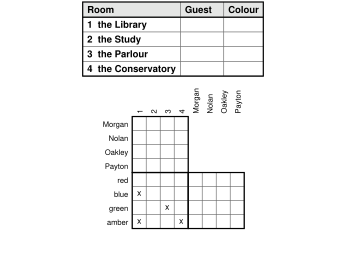
Step 1, from Clue 1. blue is out for the Library.
Step 2, from Clue 1. amber is out for the Conservatory.
Step 3, from Clue 2. amber is out for the Library.
Step 4, from Clue 2. green is out for the Parlour.
After those four steps the grid looks like this:
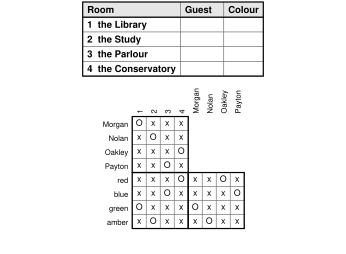
The remaining 16 steps carry on the same way, and every circle you enter rules out the rest of its row and its column in that box. The finished grid: