← All puzzle kinds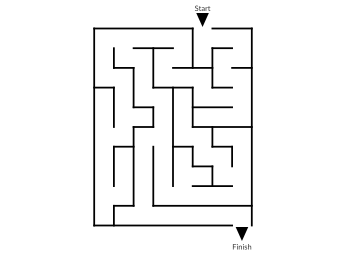
Maze
Rules
1.Go in at the arrow marked Start and find your way to the arrow marked Finish.
2.Move along the white corridors: up, down, left or right. Every line is a wall. You cannot cross a wall, and you cannot slip through the point where two walls meet.
3.There is exactly one way from Start to Finish. The maze has no loops: two corridors never lead round to the same place. This has been checked by machine for every maze in this book.
4.Most corridors end in a dead end. Walking into one is not a mistake; it is part of the puzzle.
5.The small numbers along the top and left edge count every fifth row and column. They are only there so that a hint can name a place, such as row 7, column 12.
6.The puzzle is solved when one unbroken line runs from Start to Finish.
How to solve
1.Look before you walk. A short dead end can be seen at a glance, without following it. Only the long corridors are worth walking.
2.Shade the dead ends. Find every corridor that stops, with walls on three sides, except at Start and Finish. Shade it back to the junction where it meets another corridor. Shading creates new dead ends, so go round again. When nothing is left to shade, the unshaded corridor is the way through. In these mazes this always works: they have no loops, so everything that is not on the way through ends somewhere and gets shaded sooner or later.
3.Work from both ends. Finish is as good a place to begin as Start. Draw a little way in from each end; the two lines often show where the middle has to run.
4.Mark what you have tried. A small tick at the mouth of a corridor you have walked and found closed saves walking it twice.
5.The safe way: keep one hand on the wall. Put your pencil against the right-hand wall at Start and never let go of it. In these mazes that always leads to Finish, because every wall is joined to the outer wall. It is slow: on mazes of the sizes in this book it took between 1.7 and 1.9 times as many steps as a search that skips the short dead ends.
Use 1 and 2 first. Keep 5 for the moment you are truly lost.
Worked example
A small maze with 10 rows and 8 columns. Start is on the top edge, Finish on the bottom edge.
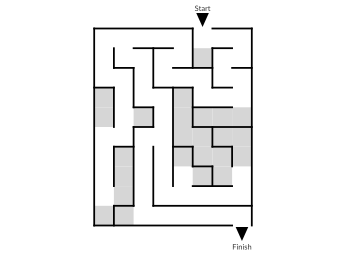
First round of shading. Leaving out Start and Finish, this maze has 11 dead ends. Each one is shaded back to its junction, 24 cells in all.
Shading has turned some junctions into new dead ends. They go in the next round, and so on: this maze needs 3 rounds.
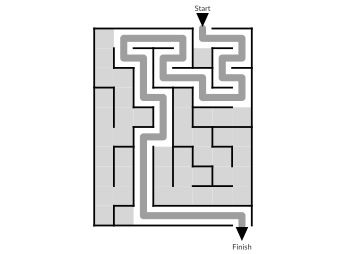
What is left unshaded is the one way through, 36 cells long. Not a single step had to be guessed: every shaded cell lay in a dead end that could be seen as one.