Rules
1.Fill the grid with the digits 1 to 9 so that every row, every column and every one of the nine 3×3 boxes contains each digit exactly once.
2.The grid is completely covered by cages, drawn with dashed lines. The small number in a cage's top-left cell is the sum of the digits in that cage.
3.No digit may repeat inside a cage.
4.There are no printed digits. The cage sums are the whole of the information. A cage of a single cell is therefore a given digit. Easy and Medium puzzles contain a few, Hard puzzles contain none.
5.No cage is larger than five cells, and every cage is one connected shape.
6.The 3×3 boxes are separated by a light background tone, the cages by dashed lines.
How to solve
1.Read the forced cages first. For some combinations of cage size and sum there is only one possible set of digits: 3 in two cells is 1+2, 4 in two cells is 1+3, 16 in two cells is 7+9, 6 in three cells is 1+2+3, 24 in three cells is 7+8+9. Those cages are your entry points. (The full table is printed with the Kakuro instructions; it applies here unchanged.)
2.The rule of 45. Every row, every column and every 3×3 box holds 1 to 9 once, so it sums to 45. Add up the cages that lie completely inside one such unit and subtract from 45, and what remains is the sum of the leftover cells. When only one cell is left over, you have its digit outright. When two or three are left over, you have a small cage of your own making, and technique 3 applies to it.
3.Play the cage out. This is the one that carries the harder grids, and it works on any cage, not just the forced ones. Take a cage and write down every way its cells can add up to its sum, using only digits each cell still allows and never the same digit twice. Then read the list twice. A digit that appears in a cell in no way is struck from that cell. A digit that appears in every way and fits only one cell of the cage belongs there. It is the same move as writing a Kakuro run out, and it is worth the effort: on a Hard grid the first two techniques run dry long before the end.
4.Singles in row, column and box. Once digits start appearing, the ordinary Sudoku deductions apply: a cell with only one candidate left, and a digit that fits only one cell of a row, column or box. Careful: the "only one cell left" argument works for rows, columns and boxes, but not for a cage: a cage need not contain any particular digit.
Worked example
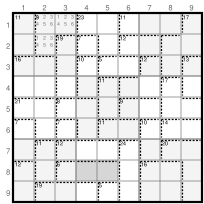
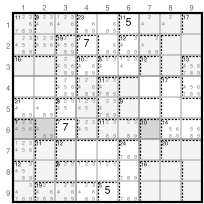
An Easy grid. The dashed outlines are the cages; the small number in a cage is the sum its digits have to reach, and no digit may repeat inside a cage. The small digits are pencil marks.
The full solution takes 207 steps, and most of them are single eliminations rather than digits written in: two thirds come from the cages, the rest from the ordinary row, column and box arguments. Shown here are the two moves that belong to the Killer alone.
The way in. The cage of r8c3, r8c4 and r8c5 adds up to 6, and 3 cells can only reach 6 one way: 1 + 2 + 3. No other digits can go there.
The 45 rule. Every row, column and box holds 1 to 9, so it adds up to 45. Take away the cages that lie wholly inside it and r6c1, r6c2, r6c4 and r6c7 must carry the rest, 13.
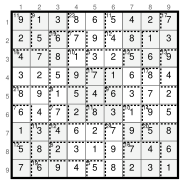
The finished grid: