Kakuro
Rules
The combination table
For many combinations of sum and run length, only one set of digits is possible. Those are your entry points. This table is complete for the run lengths that occur in this book.
| Cells | Sum | The only possible digits |
|---|---|---|
| 2 | 3 | 1 2 |
| 2 | 4 | 1 3 |
| 2 | 16 | 7 9 |
| 2 | 17 | 8 9 |
| 3 | 6 | 1 2 3 |
| 3 | 7 | 1 2 4 |
| 3 | 23 | 6 8 9 |
| 3 | 24 | 7 8 9 |
| 4 | 10 | 1 2 3 4 |
| 4 | 11 | 1 2 3 5 |
| 4 | 29 | 5 7 8 9 |
| 4 | 30 | 6 7 8 9 |
| 5 | 15 | 1 2 3 4 5 |
| 5 | 16 | 1 2 3 4 6 |
| 5 | 34 | 4 6 7 8 9 |
| 5 | 35 | 5 6 7 8 9 |
| 6 | 21 | 1 2 3 4 5 6 |
| 6 | 22 | 1 2 3 4 5 7 |
| 6 | 38 | 3 5 6 7 8 9 |
| 6 | 39 | 4 5 6 7 8 9 |
Almost as useful are sums with exactly two possible sets, where one crossing decides it:
| Cells | Sum | Either | or |
|---|---|---|---|
| 2 | 5 | 1 4 | 2 3 |
| 2 | 6 | 1 5 | 2 4 |
| 2 | 14 | 5 9 | 6 8 |
| 2 | 15 | 6 9 | 7 8 |
| 3 | 8 | 1 2 5 | 1 3 4 |
| 3 | 22 | 5 8 9 | 6 7 9 |
You need not memorize this. For a run of length L the lowest sum is 1+2+…+L and the highest is 9+8+…, and the two sums nearest each end are always forced.
How to solve
Worked example
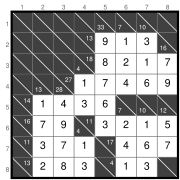
A Medium grid. Each clue cell carries the sum of the run to its right (upper number) or below it (lower number). A run never repeats a digit, and there is no zero. The small digits are pencil marks.
The full solution takes 46 of these run-by-run steps. Here are the two that matter: the way in, and the move that only Kakuro has.
The way in. A run of 2 cells that has to add up to 16 can only be made of 7 + 9: there is no other set of 2 different digits with that sum. So r6c2 and r6c3 carry those digits in some order, and nothing else.
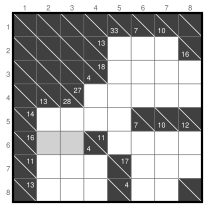
Where two runs cross. The run r5c2, r6c2, r7c2 and r8c2 has to add up to 13. Checking every set of 4 different digits that adds up to 13 leaves only part of the digits possible in each cell. Combined with what the crossing runs already allow, that settles r6c2.
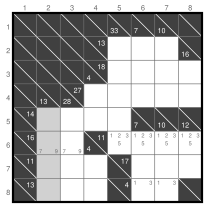
The finished grid: