Rules
1.The grid is full of numbers from the start. You write nothing in. You shade cells out until three things hold at once.
2.In every row and every column, no number appears twice among the light cells. A shaded cell no longer counts, so the same number may well stand twice in a row as long as one of the two is shaded.
3.Two shaded cells never share an edge. Corner to corner is allowed, and it happens often, so do not treat a diagonal pair as a mistake.
4.All light cells hang together in one single area, joined edge to edge. No light cell and no group of light cells may be walled off by shading.
5.Shading does not erase. The number stays readable; it simply stops counting.
6.There is exactly one solution, and reasoning always gets you there. You never have to shade a cell on spec and rub it out again.
How to solve
Mark as you go. A small dot in a cell you have decided must stay light is worth as much as the shading itself, because half the techniques below are about light cells.
The first three techniques read the printed numbers alone. They need no earlier deduction at all, which is exactly why they are the way in. Look for them in this order:
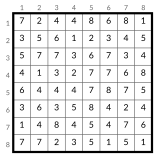
1.The triple. Three equal numbers next to each other in a row or a column. The middle one stays light, the two outer ones are shaded. (If the middle one were shaded, both of its neighbours would have to be light, and then that number would stand twice in the same line.) In an Easy puzzle: row 5 reads 6, 4, 4, 4, 7, 8, 7, 5. The 4 in column 3 stays light, the 4s in columns 2 and 4 are shaded. Three cells from one glance.
2.The sandwich. Three cells in a row reading a, b, a with a and b different. The middle cell stays light. One of the two outer cells has to be shaded, and every neighbour of a shaded cell is light, so whichever of the two it is, the cell in between survives. In the same puzzle: row 1 reads 7, 2, 4, 4, 8, 6, 8, 1. Columns 5 to 7 are 8, 6, 8, so the 6 in column 6 stays light.
3.The pair. Two equal numbers directly next to each other. They cannot both be shaded, so at least one of them stays light, and that light one already uses up this number for the line. Every further cell with that number in that same row or column is therefore shaded. The pair itself stays undecided for now. In the same puzzle: row 3 reads 5, 7, 7, 3, 6, 7, 3, 4. The two 7s in columns 2 and 3 are a pair, so the third 7 of that row, in column 6, is shaded.
4.A light cell shades its twins. Once a cell is known to stay light, every other cell with the same number in its row or its column is shaded. In the same puzzle: row 2 reads 3, 5, 6, 1, 2, 3, 4, 5. Once the 3 in column 6 is known to be light (technique 5 gets you there), the other 3 of that row, in column 1, is shaded.
5.A shaded cell lights its neighbours. All four neighbours of a shaded cell stay light, because two shaded cells never share an edge. In the same puzzle: the 7 at row 3, column 6 was shaded in 3, so row 2 column 6, row 4 column 6, row 3 column 5 and row 3 column 7 all stay light.
6.Keep the light area whole. A cell whose shading would cut light cells off from the rest is light. And a cell the light area cannot reach at all, even over cells that might still turn light, is shaded. Corners and edges are where this bites hardest, because a cell there has only two or three ways out. In the same puzzle: at one point row 2 column 1 and row 3 column 2 are both shaded, and row 3 column 1 is light. That light cell has only one way out left, downwards through row 4, column 1. Shading it would cut the cell off, so row 4, column 1 is light.
7.The short trial. When nothing above moves any more, take one open cell, assume one colour for it, and follow techniques 1 to 6 from there. Keep it short: at most three passes and at most eight cells. If that runs into a contradiction, the cell has the other colour. If it does not, put the assumption back and try somewhere else. This is not guessing, because nothing is ever entered and taken back on the page; it is a short look ahead. In a Hard puzzle: techniques 1 to 6 stall with exactly three cells open, at row 1 columns 1 and 2 and row 2 column 1, and all three carry a 3. Suppose the corner cell stays light. Then both of the other 3s, the one beside it and the one below it, have to be shaded. But those are the corner's only two neighbours, so the corner would be walled off from every other light cell. So the corner is shaded, and its two neighbours are light.
Easy and Medium both end at technique 6 and differ only in how long the chain is. Hard is the level that needs the short trial.
One shortcut, and why it is only that
There is a well known Hitori move that is not in the list above: a number that appears only once in its row and only once in its column can be set light safely, so it stays light. This does not follow from the three rules. It follows from the promise that the puzzle has exactly one solution: if such a cell were shaded, you could light it again and have a second valid solution.
It is a fine shortcut and it saves real work. In one Easy puzzle of this book it hands the reader 28 of the 64 cells as light, free of charge. But it decides nothing: it only lights cells that were never going to be shaded anyway. No puzzle in this book needs it. Every one of them comes out with techniques 1 to 7, and that was checked by machine over 11188 grids, on which this shortcut was the deciding move exactly zero times. Use it to save pencil work, not to solve.
Worked example
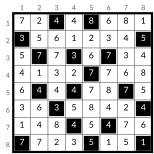
Easy, 8x8. The whole solution takes 48 single deductions and shades 18 cells.
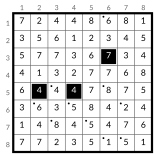
The small grey numbers along the edges count rows and columns; they are not printed on the puzzle pages. A shaded cell is black, with its number still readable in white, and a dot marks a cell already known to stay light.
Step 1, read the number picture. Before a single cell is decided, three patterns are already there to be seen.
•The triple 4, 4, 4 in row 5, columns 2 to 4: the middle one light, the outer two shaded.
•The pair 7, 7 in row 3, columns 2 and 3: the third 7 of that row, in column 6, is shaded.
•Nine sandwiches, among them 8, 6, 8 in row 1 columns 5 to 7, 7, 8, 7 in row 5 columns 5 to 7, 3, 6, 3 in row 6 columns 1 to 3, 4, 2, 4 in row 6 columns 6 to 8, 4, 8, 4 and 4, 5, 4 in row 7, 5, 1, 5 and 1, 5, 1 in row 8, and 4, 5, 4 down column 4 in rows 5 to 7. Each of them lights its middle cell.
That is thirteen cells in eleven moves, off the printed page alone and spread over the whole grid:
Step 2, the shaded 7 lights its neighbours. Row 3, column 6 is shaded, so row 2 column 6, row 4 column 6, row 3 column 5 and row 3 column 7 are light.
Step 3, a light cell shades its twins. Row 2, column 6 holds a 3 and is now light. The only other 3 in that row stands at row 2, column 1, so that one is shaded.
Step 4, and that one lights again. Row 2, column 1 is shaded, so row 1 column 1, row 3 column 1 and row 2 column 2 are light. The 7 at row 1, column 1 then shades the 7 at row 8, column 1, and the 5 at row 2, column 2 shades the 5 at row 2, column 8.
Steps 3 and 4 now simply take turns until the grid is full. Over the whole solve that is 15 twin shadings, 14 neighbour lightings, the 11 pattern reads from step 1 and 8 places where the light area had to be kept whole.