Rules
1.Fill the 6x6 grid so that every row and every column holds the digits 1 to 6, each exactly once.
2.Between some pairs of neighbouring cells stands a sign. Its tip always points at the smaller of the two numbers.
3.A sign speaks about those two cells only. It says nothing about the rest of the row or the column, and it never reaches across a cell.
4.Where no sign is printed, nothing is said. The two neighbours may stand in either order. A missing sign is a left out statement, not a hidden hint, and it does not make the two cells free or equal either. Everything else in that row and column goes on holding.
5.You will never find a sign between two printed digits. Such a sign would already be satisfied before you pick up the pencil, so it is left out. Here too the gap tells you nothing.
6.Printed digits are gifts. They stay as they are.
7.There is exactly one solution, and reasoning always gets you there. You never have to enter a digit on spec and rub it out again. Futoshiki in this book has no trial rule at all.
How to solve
Write the still possible digits small into the open cells. The signs work by cutting that list down, and without the list on paper there is nothing to cut.
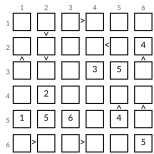
1.Cross out. A digit that stands somewhere is gone from the rest of its row and the rest of its column. In an Easy puzzle: row 5 is printed as 1, 5, 6, ., 4, . Only 2 and 3 are left, so both open cells of that row carry the pair 2 and 3 and nothing else.
2.The last one standing. If a cell has only one digit left, that is its digit. In the same puzzle: column 4 already shows the printed 3 in row 3. That takes the 3 away from row 5, column 4, and the 2 is all that remains. So row 5, column 4 is a 2, and the other open cell of row 5 is the 3.
3.Read the sign. At every sign the small side must stay under the largest number the big side can still take, and the big side must stay above the smallest number the small side can still take. Two ends of that rule are worth memorising: a 1 never sits on the big side of a sign, and a 6 never sits on the small side. In another Easy puzzle: row 4 begins with a printed 5 and a sign pointing at it. The neighbour has to be larger than 5, so it is a 6, with nothing else to weigh up. Further along the same row the printed 3 in column 4 points at its right neighbour, which is therefore a 1 or a 2.
4.Follow the chain. Apply rule 3, then apply it again with the shortened lists. Signs that hang together in the same direction tighten each other. In a third Easy puzzle: row 6 carries two signs in a row, so the cell in column 4 is smaller than the one in column 3, which is smaller than the one in column 2. Three cells rising means the last of them is at least 3 and the first at most 4. In the solution they read 6, 4 and 1.
5.Only one home left. If a digit fits in only one cell of a row or a column, it belongs there, even when that cell would still allow other digits. In a Medium puzzle: in column 2 five of the six cells are the small side of a sign, so none of them can be a 6. Only row 2 is left, and that is where the 6 goes.
6.The pair that blocks. If two cells of the same row or column carry the same two digits and nothing else, those two digits are used up there. Cross them out of every other cell of that line. In a Hard puzzle: at one point in the solve the cells in rows 2 and 5 of column 4 both read "2 or 3". The 2 and the 3 of that column are therefore spoken for, and the four other cells of column 4 lose both.
7.Play out a line. Take one row or one column and write down the orders that fit the remaining lists and the signs inside that line. Whatever never appears in a place is impossible there. This is the technique that cracks a hard Futoshiki, and the reason a puzzle can be hard without any guessing. In the same Hard puzzle: row 5 reads, at that stage, "2 3 5 6", "1 2 3 5", "2 3 5 6", "2 or 3", "1 or 2", 4. The 5 and the 6 of that row can only go in the first three cells. Two signs inside the row make the second cell smaller than the first and smaller than the third, so it cannot be one of the two largest. The 5 and the 6 therefore sit in columns 1 and 3.
Work 1 to 4 until nothing moves, then 5 and 6, and keep 7 for the moment the row refuses to give anything up. The level tells you how far you will have to go: Easy needs 1 to 4, Medium adds 5 and 6, Hard adds 7.
Worked example
Easy, 6x6. The full solution takes 39 single deductions, every one of them from techniques 1 to 4. Here is the opening.
The small grey numbers along the edges count rows and columns; they are not printed on the puzzle pages. The tip of every sign points at the smaller of its two numbers.
Step 1, cross out. Row 5 shows 1, 5, 6 and 4. The two open cells, in columns 4 and 6, can only be 2 or 3.
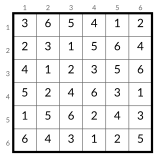
Step 2, the last one standing. Column 4 carries the printed 3 in row 3. That strikes the 3 out of row 5, column 4, which leaves the 2. Row 5 now reads 1, 5, 6, 2, 4, 3.
Step 3, read the sign. Look at row 6, column 4. Its row already shows the printed 5, its column shows the printed 3 and the 2 from step 2, so only 1, 4 and 6 are left. The sign between columns 3 and 4 points at column 4, so this cell has to stay under its left neighbour. And that neighbour can be at most a 4: row 6 has its 5 already, and the printed 6 in row 5 blocks the 6 of column 3. So row 6, column 4 is the 1.
Step 4, the small side is never a 6. Row 2, column 4 sits on the small side of a sign, so it cannot be a 6. Its row shows the printed 4 and its column the 3 and the 2, which leaves 1 and 5. The 1 of column 4 has just gone to row 6, so this cell is a 5. Its neighbour on the big side must beat a 5, and that makes row 2, column 5 a 6.
Step 5, read the sign once more. In column 6 the sign between rows 4 and 5 points upwards, so row 4, column 6 is smaller than row 5, column 6, which is the 3 from step 2. Column 6 shows the printed 4 and 5 as well, and row 4 has its 2, so only 1 and 6 were left there. Under a 3 only the 1 survives.
From here the same two moves carry the rest. Thirty of the thirty nine deductions are plain crossing out, nine come from the signs, and neither the hidden single nor the pair is needed.