Rules
1.Every cell of the grid holds one of two shapes: a circle or a cross. Some are printed; the rest are yours to draw in. There is no third option: a cell you have not decided yet is simply still empty.
2.Every row and every column holds as many circles as crosses. In a 6x6 grid that is three of each, in an 8x8 grid four of each. The grid always has an even number of rows.
3.Never three of the same shape in a line: neither horizontally nor vertically. Two in a row are fine, three are not.
4.No two rows may be identical, and no two columns may be identical. Because every line holds the same number of each shape, two finished lines can never differ in just one cell: they differ in at least two. Two rows that agree in all but two cells are allowed and happen often.
5.Diagonals carry no rule at all.
6.The puzzle is solved when the grid is full and rules 2 to 4 hold everywhere. There is exactly one such filling.
The four rules of deduction
Every puzzle in this book can be solved with the four rules below and nothing else. The difficulty label says how far the first three carry you, because rule D is the slow one and the moment you need it is the moment a puzzle turns hard:
•Easy: rules A, B and C carry it through, and at the tightest moment four or more deductions lie open at once.
•Medium: A, B and C still carry it, but at the tightest moment only one to three are open, and you have to find them.
•Hard: A, B and C run out. Somewhere you will have to write a line out in full, which is rule D.
•A. Avoid the third. Two equal shapes standing next to each other force the opposite shape on both sides of the pair. Two equal shapes with one empty cell between them force the opposite shape into that gap. Three patterns in all: a pair with an empty cell to its right, a pair with an empty cell to its left, and a gap between two equals.
•B. Balance. As soon as one shape has reached its quota in a line, say three circles in a row of six, every remaining cell of that line takes the other shape. This is the rule that finishes lines, and it is worth re-checking every time you fill a cell.
•C. No twin lines. When a line is missing exactly two cells and is one short of each shape, there are only two ways to fill it. If one of those two ways would make it identical to a line of the same direction that is already complete, that way is out, and the other one is forced.
•D. Write the line out. Take one line that still has gaps and list every filling it allows: no three alike, the right number of each shape, and not a copy of a line of the same direction that is already finished. Usually only a handful survive. Whatever stands the same in every one of them is settled, even where none of A, B or C sees anything. This is the rule that carries the Hard puzzles, and it is worth the paper: without it a Hard grid would need about a fifth more printed shapes to stay solvable, and every printed shape is one you do not get to work out.
Work A until it stalls, then B, then look for C, and reach for D last. After every filled cell go back to A: one new shape usually creates a new pair, and a new pair is a new deduction.
How to solve
1.Scan the grid for pairs and gaps, which is rule A. On an Easy puzzle this alone gets you most of the way.
2.Count each row and each column as you go, and apply rule B the moment a quota is full. Counting is not optional here: it is the cheapest deduction in the puzzle, and it costs nothing but attention.
3.Only when both stall, look for a line with exactly two cells left and compare it with the finished lines in the same direction, which is rule C.
4.When even that stalls, pick a line and write out every filling it still allows, which is rule D. It is slower than the others, so it is the last resort, but on a Hard grid it is what gets you moving again.
Worked example
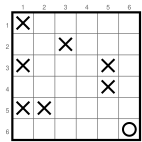
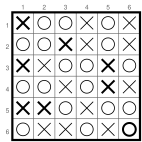
A 6×6 grid, Hard. The thick shapes are the ones printed in the puzzle; everything thin is entered while solving. The full solution takes 25 steps. Shown here is the first time each rule is needed.
Step 1, rule A. In row 5, r5c1 and r5c2 are two crosses side by side. A third would make three in a line, so r5c3 is a circle.
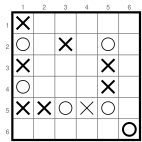
Five more steps of the same kind follow. The grid now looks like this:
Step 7, rule B. Row 5 already holds 3 crosses, and a line of 6 holds exactly 3 of each. Its quota is full, so the one remaining cell is a circle.
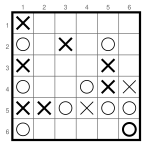
Three more steps follow. The grid now looks like this:
Step 11, rule D. Row 2 has only a few fillings left that keep every rule. Writing them all out, one cell is the same in every one, so it is settled.
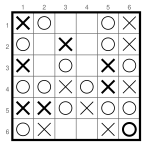
Eight more steps follow. The grid now looks like this:
Step 20, rule C. Column 3 has two cells left, and one of the two fillings would make it identical to a column that is already finished. No two columns may be the same, so r1c3 is a circle and r6c3 a cross.
The last steps are rules A and C again, and the grid closes itself: