Rules
1.Fill the 6x6 grid so that every row and every column holds the digits 1 to 6, each exactly once.
2.The grid is cut into cages, outlined in heavy lines. Each cage carries a small mark in its top left corner: a number and an operator. The digits of that cage, in any order, must give the number when the operator is applied to them.
3.A cage of a single cell carries only a number. That is a given digit.
4.Plus and times can appear on a cage of any size. Minus and divide only ever appear on a cage of exactly two cells. Subtraction takes the smaller from the larger, so the result is never negative, and division always comes out whole, so the larger digit is a clean multiple of the smaller one. You never have to work out which way round it goes.
5.Inside a cage a digit may appear twice, as long as the two cells are not in the same row and not in the same column. That is why bent cages are more interesting than straight ones: a straight cage lies in one line and can never repeat.
6.Every cage hangs together across edges, never only at a corner.
7.There is exactly one solution, and reasoning always gets you there. You never have to enter a digit on spec and rub it out again. Calcudoku in this book has no trial rule at all.
Where to start
The hard part of a Calcudoku is not the arithmetic, it is finding the first cage worth looking at. Go through the grid in this order and the opening comes by itself.
1.The single cells first. They are gifts, and they cost you nothing.
2.Then the two cell cages with an extreme mark, that is a very small or a very large number. Those often allow only one pair. In a 6x6 a 3+ can only be 1 and 2, a 11+ only 5 and 6, a 30x only 5 and 6, a 5- only 1 and 6.
3.Then the three cell cages with the highest or lowest mark they could carry. A 17+ on three cells is 6, 6 and 5 and nothing else. A 7+ on three cells that lie in one column is 1, 2 and 4.
4.Only then walk the rows and the columns and ask which digit still has one home left in that line.
This is not a promise made lightly. Every easy puzzle in this book has been measured before it was printed: the first pass through that list, with no chaining at all, always fixes at least four of the 36 cells, and those cells always lie in at least three of the four quarters of the grid. In practice it hands you a good deal more, usually a quarter of the grid or better and now and then half of it. How much more depends on the puzzle, which is why no number is promised here. What is promised is that there is a way in, and that it is not hidden in one corner.
How to solve
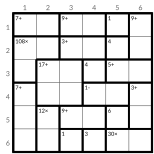
1.Single cage. One cell, one number, done. In an Easy puzzle: six cages of one cell each, at row 1 column 5, row 2 column 5, row 3 column 4, row 5 column 5, row 6 column 3 and row 6 column 4.
2.Two cell cage. Write down every pair of digits that fits, and cross out of both cells whatever appears in no pair. In the same puzzle: 3+ on row 2, columns 3 and 4 can only be 1 and 2, because no other two digits of a 6x6 add up to 3. 30x on row 6, columns 5 and 6 can only be 5 and 6. And 1- on row 4, columns 4 and 5 allows five pairs, from 1 and 2 up to 5 and 6, so it tells you almost nothing on its own. A small mark is not automatically a strong one.
3.The cage with only one set of digits. Some cages of three, four or more cells admit exactly one collection of digits, even though it is still open which digit goes where. Then those digits are fixed for that cage and everything else falls out of its cells. You do not have to work through all the combinations, only to see that there is only one. In the same puzzle: 108x on row 2 columns 1 and 2 plus row 3 column 1. The only way to make 108 out of digits 1 to 6 is 3 times 6 times 6. And: 7+ on row 4, 5 and 6 of column 1. All three cells sit in one column, so the digits are different, and the only three different digits adding to 7 are 1, 2 and 4.
4.The repeat lies across the corner. If a cage uses a digit twice, the two cells must not share a row or a column, so they sit diagonally to each other. That often settles the whole cage. In the same puzzle: in the 108x cage the cell at row 2, column 1 shares its row with one partner and its column with the other. It cannot be one of the two sixes, so it is the 3, and the sixes take the other two cells.
5.Cross out. A digit that stands somewhere is gone from the rest of its row and the rest of its column. In the same puzzle: the given 1 at row 1, column 5 clears the 1 out of the whole of row 1 and of column 5.
6.Only one home left. If a digit fits in only one cell of a row or a column, it belongs there. In a Medium puzzle: the 24x on the top two cells of column 1 can only be 4 and 6. The 8+ on the bottom three cells of the same column is either 1, 2 and 5 or 1, 3 and 4, and the 4 has just been taken, so it is 1, 2 and 5. Now the 3 of column 1 has only the middle cell, row 3, left.
7.Three cell cage. The same counting as in 2, with three cells. In the same puzzle: 40x on row 2 column 4 plus row 3 columns 3 and 4 is 2 times 4 times 5 and nothing else. 6+ on row 4 columns 3 and 4 plus row 5 column 3 is either 1, 1 and 4 or 1, 2 and 3. In the first of those the two ones have to lie diagonally, which leaves only one place for the 4.
8.The pair and the triple that block. If two cells of a line carry the same two digits and nothing else, or three cells carry the same three, those digits are used up there and can be crossed out of the rest of the line. In the same puzzle: the 24x pair of 4 and 6 in the top two cells of column 1 clears the 4 and the 6 out of the four cells below it.
9.Four cell cage. The same counting again, with four cells. This is where a table helps, and it is reserved for the hard puzzles. In a Hard puzzle: 90x over row 3 columns 4 and 5 and row 4 columns 3 and 4 is either 1, 3, 5 and 6 or 2, 3, 3 and 5. Both leave out the 4, so the 4 is gone from all four cells before anything else is known.
10.The cage that points. If a digit appears in every possible filling of a cage, and all the cells where it could sit lie in the same row or the same column, then that row or column has its copy of the digit inside the cage. Cross the digit out of the rest of that line, even though you still do not know where in the cage it sits. In the same puzzle: 12x on rows 2, 3 and 4 of column 1 is either 1, 2 and 6 or 1, 3 and 4. Both contain the 1, and all three cells are in column 1, so the 1 of column 1 is in this cage. The three other cells of the column lose it.
11.What the line has left over. Every row and every column adds up to 1+2+3+4+5+6, that is 21. If some cages lie completely inside one line and their digit sums are known, subtract them. The rest has to make up the difference. In another Hard puzzle: in column 2 exactly one cage lies wholly inside, a 12+ on the bottom three cells. So the top three cells of that column add up to 21 minus 12, that is 9, and only a few triples do that.
Techniques 1 to 6 carry an Easy puzzle. Medium adds 7 and 8. Hard adds 9, 10 and 11. There is no trial technique at any level.
Worked example
Easy, 6x6, 19 cages of which 6 are single cells.
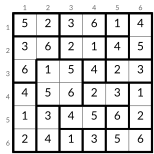
The small grey numbers along the edges count rows and columns; they are not printed on the puzzle pages. Heavy lines are cage borders, and the mark of a cage stands in its top left cell. The solution shows the digits and the cages, without the marks.
Step 1, the gifts. Six cages hold a single cell. Write them in at once: a 1 at row 1 column 5, a 4 at row 2 column 5, a 4 at row 3 column 4, a 6 at row 5 column 5, a 1 at row 6 column 3 and a 3 at row 6 column 4.
Step 2, the extreme pairs. 3+ on row 2, columns 3 and 4 is the smallest sum two cells can carry, so it is 1 and 2. 30x on row 6, columns 5 and 6 is 5 times 6. Two cages, four cells, no arithmetic worth the name.
Step 3, finish row 6. That row now shows a 1, a 3 and the pair 5 and 6. Column 5 already carries the 6 from step 1, so the 6 of row 6 cannot stand in column 5. Row 6, column 5 is the 5 and row 6, column 6 is the 6.
Step 4, the three cell cages with an extreme mark. 108x on row 2, columns 1 and 2, together with row 3, column 1: the only way to reach 108 with digits 1 to 6 is 3 times 6 times 6. The cell at row 2, column 1 shares its row with one of its partners and its column with the other, so it cannot be one of the two sixes. It is the 3, and the sixes go to row 2 column 2 and row 3 column 1.
Step 5, the other one. 7+ on rows 4, 5 and 6 of column 1. All three lie in one column, so all three digits differ, and 1 plus 2 plus 4 is the only way.
Step 6, column 1 is spoken for. Rows 2 and 3 of that column hold the 3 and the 6, rows 4, 5 and 6 hold the 1, the 2 and the 4. Only the 5 is left, and only row 1 is left to hold it. Row 1, column 1 is a 5, and the 7+ of that row makes row 1, column 2 a 2.
From here the puzzle runs on the same four moves. All told it takes 64 single deductions: 37 of them are cage arithmetic on one or two cells, 3 are cages read as a single set of digits, and 24 are plain crossing out. Nothing deeper is needed.