Rules
1.The circles are islands. The number in a circle is printed and never changes.
2.Join islands with bridges. A bridge is a straight line, horizontal or vertical only: never diagonal, and never with a bend. It always runs from one island to the next island in that direction.
3.Up to two bridges may join the same pair of islands. A double bridge is drawn as two parallel lines, and it counts as two. This is the rule people miss most often: without it, an island marked 5, 6 or more looks impossible.
4.Bridges never cross one another, and never pass over an island.
5.The number on an island is exactly how many bridges end there, a double bridge counting twice. Not at least, not at most: exactly.
6.All islands must form one connected network. When you are done, you can walk along the bridges from every island to every other one.
How to solve
1.Counting: an island's partners. An island can only be joined to the nearest island up, down, left and right, and only if nothing stands in between. Each of those lines carries 0, 1 or 2 bridges, so an island with N partners takes at most 2N. If its number equals that maximum, every one of its bridges is double. An island marked 4 with only two partners is the classic opening.
2.Counting: one partner. An island with a single partner puts its whole number on that one line.
3.Counting: what the others bring. For any line, look at what the island's other lines bring. What they bring for certain caps this line: if the other lines of a 3 already carry 3, this one stays empty. What they can bring at most sets a floor: a 5 with three partners needs at least one bridge on every line, because two double bridges only make 4.
4.Crossing. A bridge that is certain blocks every line that would cross it. Those lines stay empty.
5.Looking ahead. When counting and crossing find nothing, take one line and suppose it carried a particular number of bridges. Follow counting and crossing from there. If a group of islands ends up finished, every number in it satisfied but cut off from the rest, that choice is wrong: the network would fall apart. The same holds if some island can no longer get its number. The classic case is two islands marked 1 facing each other. A bridge between them would satisfy both at once and seal them off, so it is only allowed if those two islands are the whole puzzle. The same goes for two 2s joined by a double bridge.
Work 1 to 3 until they stall, then 4, and use 5 only when nothing else moves. After every new bridge, go back to counting.
The difficulty label says which of these a puzzle needs. Easy: counting alone solves it. Medium: counting and crossing. Hard: somewhere the numbers alone would still allow a second answer that falls apart into separate pieces, so you need technique 5 and the rule that everything hangs together.
Worked example
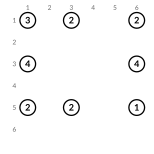
A 6×6 grid, Hard, with 8 islands. The full solution takes 20 steps; shown here is the first time each technique is needed. The row and column numbers are only for this explanation. A single line is one bridge, two parallel lines are a double bridge, and a dashed line means at least one bridge, with the second still open.
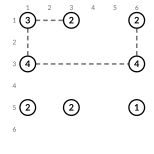
Step 1, counting. The 3 in row 1, column 1 needs 3 and has 2 possible partners. Look at its line to the 2 in row 1, column 3: the island's other lines can bring at most 2, so this line must carry at least 1. So that line carries at least one bridge.
Seven more steps of the same kind follow. The grid now looks like this:
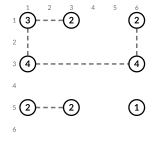
Step 9, crossing. The bridge between row 3, column 1 and row 3, column 6 is certain. The line between row 1, column 3 and row 5, column 3 would cross it, so it stays empty.
Two more steps follow. The grid now looks like this:
Step 12, looking ahead. Suppose the line between row 1, column 1 and row 1, column 3 carried a single bridge. Follow the counting and crossing rules from there: a group of islands ends up finished, every number in it satisfied, but cut off from the rest. The network would fall apart. So the line is a double bridge.
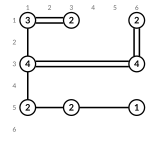
The last 8 steps use counting again, and the network closes:
Every number is satisfied, no two bridges cross, and you can walk from any island to any other one.